
Pivot‑TR / Pivot Bridge®
Temporary implantStabilize today. Decide what comes next.
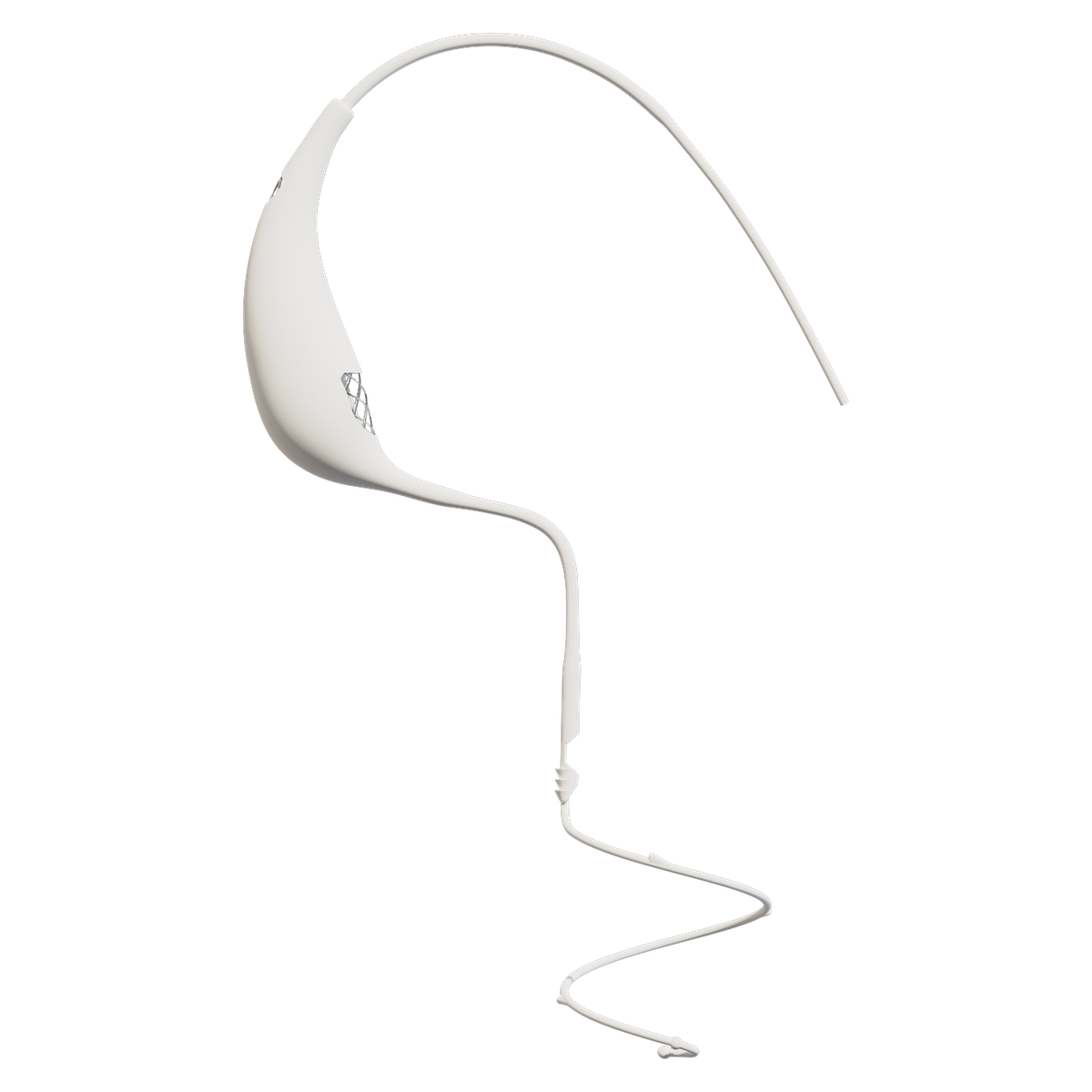
Pivot Bridge® is a temporary, flow-aligned spacer for secondary tricuspid regurgitation, designed to stabilize high‑risk patients and prepare them for definitive therapy.
 Adobe Stock preview · not licensed
 Technology
A short-term preoperative stabilization device, placed for up to three weeks prior to definitive treatment.
Pivot Bridge® reduces TR while the patient’s condition is optimized, and helps clinicians assess how the heart responds before committing to surgery, transcatheter repair, or replacement.
Procedure
Quick to place. Designed to come out.
Pivot Bridge® is placed through the femoral vein with standard catheter techniques and minimal reliance on advanced imaging, suited to critically ill patients who need pre-operative stabilization.
- 01Femoral vein
- 02Inferior vena cava
- 03Right atrium
- 04Pulmonary artery
temporary implantation
estimated procedure time
mean procedure time in the first‑in‑human study
Components
Three parts, no fixation.
IVC anchor
A spiral structure in the inferior vena cava holds the proximal end without sutures, clips, or tissue penetration.
Flow-window spacer
A spacer with flow windows sits across the valve, letting blood pass through and around the device while the leaflets coapt on its surface.
PA anchor
An atraumatic extension into the pulmonary artery stabilizes the distal end along the flow axis, preventing migration.
Benefits
Designed around the patient and the procedure.

- Immediate TR reduction
- In the first‑in‑human study, TR was reduced by at least one grade in every patient.
- Flow through the device
- Flow windows let blood pass through and around the spacer.
- Self-centering
- Stays centered within the valve during systole.

- Designed for removal
- Fully catheter-retrievable, or removed manually at the time of surgery.
- Non-fixated anchoring
- IVC and PA anchors hold the device without tissue penetration.
- Leaflet integrity
- Supports coaptation without leaflet fixation or trauma.

- Bridge to definitive therapy
- A path to surgery, transcatheter repair, or replacement.
- Diagnostic insight
- Shows how the heart responds to TR reduction before a permanent decision.
- For fragile patients
- Rapid, fluoroscopy-guided placement for critically ill patients.
Clinical rationale
A staged reduction strategy for frail and high-risk patients.
Pivot Bridge® provides temporary tricuspid regurgitation (TR) reduction, allowing clinicians to stabilize high-risk patients and assess how the heart responds before committing to definitive therapy.
Why a staged reduction
Gradual step-down reduction of TR may remove the risk of abrupt changes to ventricular loading prior to surgical intervention.
Abrupt correction produces a transient stress peak; gradual correction blunts that response.
Ventricular wall stress after TR correction (simulation)
Redrawn from cardiovascular modelling of tricuspid regurgitation correction by Walmsley et al., EuroIntervention 2019.1 Values are simulated, not patient measurements.
- 01
Avoid abrupt hemodynamic stress
Sudden elimination of severe TR can impose an acute loading change on a failing right ventricle. A staged reduction may help soften that transition.
- 02
Stabilize before a permanent decision
Temporary TR reduction may improve congestion and overall clinical status, helping some patients reach a better condition for definitive therapy.
- 03
Allow time for evaluation and optimization
A temporary implant can create time for additional assessment, medical optimization, and multidisciplinary planning before surgery or transcatheter intervention.
- 04
Potentially broaden treatment options
Anatomical or clinical improvement may bring some patients once considered high-risk or suboptimal back into consideration for surgical repair, replacement, or transcatheter repair.
Key takeawayTemporary TR reduction may stabilize frail patients, support right-heart recovery, and create a clearer path to definitive therapy.
 Adobe Stock preview · not licensed
 Designed to give high‑risk patients a safer path to definitive treatment.
Full specifications
ShowHide
- Intended use
- Pre-habilitation and diagnostic use, in preparation for definitive therapy
- Target disease
- Secondary tricuspid regurgitation
- TR severity treated
- Inclusive of massive and torrential TR
- Target population
- High-risk, frail, or inoperable patients with severe TR
- Implant duration
- Temporary, up to 3 weeks
- Deployment
- Transfemoral venous access, transcatheter
- Removal
- Removable by transcatheter retrieval, or manually at the time of surgery
- Anchoring
- Atraumatic, non-fixated anchoring (IVC + PA)
- Spacer design
- Self-centering oblong spacer with flow apertures
- Valve interaction
- Supports leaflet coaptation without fixation or leaflet trauma
- Flow preservation
- Designed for hemodynamic flow through and around the device
- Adaptability
- Dynamic self-centering, adaptable to progressive cardiac remodeling
- Procedural setting
- Percutaneous intervention in the cath lab or hybrid OR
- Customization
- Bridge to surgery, transcatheter repair, or replacement
- Imaging
- Fluoroscopy-guided; TEE or ICE not required
- Retrievability
- Fully catheter-retrievable; designed for removal
- Est. procedure time
- About 60 minutes
- Learning curve
- Low; designed for rapid adoption by interventional teams
- First-in-humanCCI 202615 patients, TR reduced in every patient
- Clinical studyNCT07385625Acute safety and efficacy study
Specifications as provided by Tau Medical. Investigational device, not commercially available.
Compare the two devices.
Pivot Extend and Pivot Bridge share one platform and differ in intended use and duration.
References
- Walmsley J, Squara P, Wolfhard U, Cornelussen R, Lumens J. Impact of abrupt versus gradual correction of mitral and tricuspid regurgitation: a modelling study. EuroIntervention. 2019;15(10):902-911. eurointervention.pcronline.com